
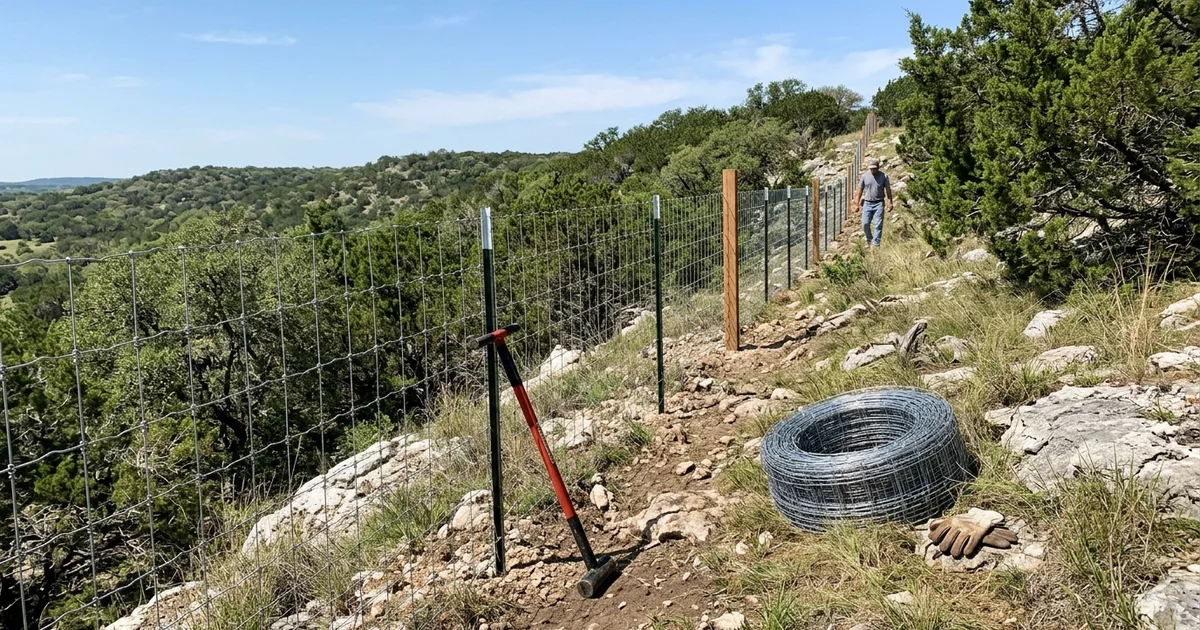
A high game fence is built to keep deer out or to hold deer and exotic game in, and it takes more than a tall pasture fence. It's an 8 ft fence of tight wire on heavy posts, with corners braced hard enough to hold that wire for the long haul.
Here's how a high game fence is built on Texas Hill Country acreage, step by step, and where they usually go wrong.
What Makes a High Fence Different
A regular pasture fence is built to hold cattle that lean on it. A high fence has to stand up to deer and exotics that push, jump and look for a way under. That takes an 8 ft barrier, heavily braced corners and wire stretched tight, and every weak spot matters over thousands of feet of fence.
Deer and game fencing runs $8 to $20 per foot, and full 8 ft acreage fence sits toward the upper end. Rock and rough terrain push a job higher. The wire is different too. High game fence uses high-tensile, fixed-knot wire, which holds its shape better than standard wire.
Step 1: Plan and Clear the Line
We start every project by establishing a clear, perfectly straight line. Brush, cedar bushes, and low tree limbs push the wire out of alignment. This interference makes it impossible to stretch the wire tight, leaving gaps that animals easily exploit.
The first step is going over the whole perimeter, flagging the route and planning any clearing. Long, straight runs minimize the need for extra corner assemblies, which reduces your total cost per linear foot. This initial phase is also the exact time to mark corners, gates, and every low spot the line crosses.
Pre-clearing planning requires checking a few vital details:
- Terrain Assessment: Identify steep grades that require specialized drilling equipment.
- Property Boundaries: Verify exact lines to prevent costly boundary disputes.
- Water Features: Mark creeks or draws where the steel wire will cross.
- Equipment Access: Ensure access roads are wide enough for material delivery trucks.
Step 2: Set Corners and Braces in Rock
Corner and brace posts are the backbone of the fence. A stretched 8 ft fence pulls hard on its ends, and all that pull lands on the braces at every corner, gate and change in grade.
In the stony uplands around Boerne, Comfort and Sisterdale, that means drilling into the limestone with a rock auger, then setting heavy steel pipe posts in concrete. If an anchor shifts, the wire goes slack.
| Part | What it does | Usually made of |
|---|---|---|
| Corner posts | Anchor each end against wire tension | Heavy steel pipe |
| H-braces | Tie corner posts to a second post for stability | Welded steel |
| Line posts | Hold the wire up between braces | Steel pipe or heavy T-posts |
| Wire | Fixed-knot mesh stretched tight | Galvanized high-tensile wire |
| Gates | Close tight to the ground at full height | Welded pipe frames |
Step 3: Line Posts
Line posts go in between the braces to hold the wire at height. How far apart they go depends on the wire and the ground. They're usually steel pipe or tall, heavy T-posts. On shallow, rocky ground, line posts often need drilling too, so they sit deep enough not to lean when deer or exotics push on the fence.
- Steel pipe: the strongest choice for rocky ground.
- Heavy steel T-posts: cost less, and work where the soil is deeper.
- Drill stem pipe: used oilfield pipe, a common choice on Texas ranches.
Step 4: Stretch the Wire
We use fixed-knot wire because the knot locks the vertical and horizontal wires together, so the fence holds its shape when animals hit it. It's galvanized high-tensile wire, with the openings tighter near the bottom to keep small animals out and wider near the top.
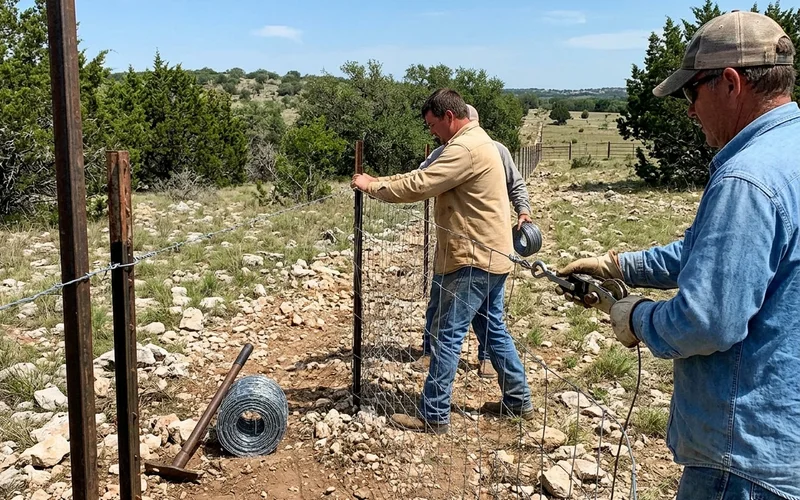
The wire is stretched tight between the H-braces, tied off, and fastened to each line post. Getting the tension right is what keeps an 8-foot fence standing straight for years.
Step 5: Low Spots and Creek Crossings
We spend extra time on low spots, because that's where game gets under. Where the property line crosses a draw, a dip, or a creek, the ground naturally drops away from the bottom tension wire. A rigid high fence will bridge across these gaps, leaving a wide-open entry point.
Our solution for streams and creeks is installing specialized water gap fencing. These custom barriers hang down to close the gap during dry conditions but are designed to swing outward during heavy floods. Allowing floodwater and heavy debris to pass through prevents the entire structure from collapsing under water pressure.
Key benefits of installing water gap fencing:
- Debris Management: Swings open to let branches and logs pass safely.
- Flood Protection: Prevents the main fence line from collapsing under heavy water pressure.
- Continuous Security: Swings back down when the water goes down.
Step 6: Gates
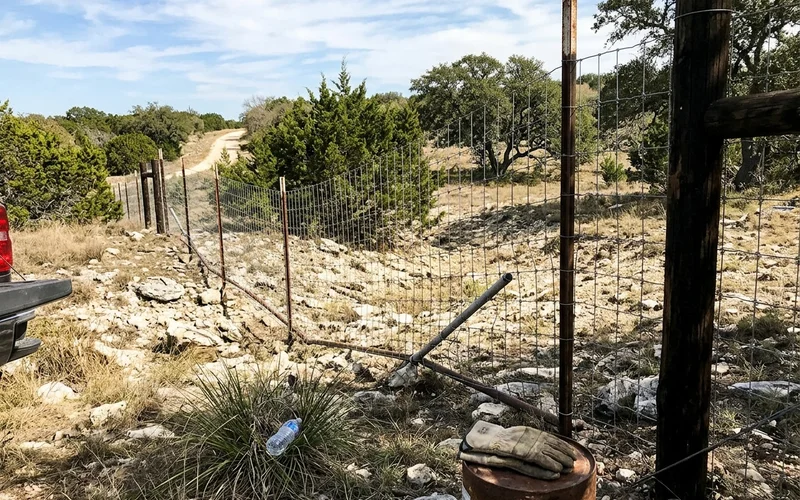
Gates go in at the full 8 ft height, so deer can't jump the gap, and they close tight to the ground with nothing open at the hinge side. Main ranch entries need to be wide enough for trailers and trucks.
We build ranch gates from heavy steel pipe so they don't sag, and a solar-powered operator can automate the main entrance where there's no power at the road. Check the hinges and latches now and then to keep heavy gates working smoothly.
Step 7: Check the Whole Fence
When the fence is done, we go over the whole line looking for gaps, loose ties, and spots where the bottom wire lifts off the ground. Even a small gap in a dry creek bed is a way in, so it gets fixed before we call the fence finished.
How Long and How Much?
Total footage decides the budget. A square 10-acre tract takes about 2,640 feet of fence. At $8 to $20 per foot, that's $21,120 to $52,800 before gates or water gaps.
Bigger properties add up fast. A mile of fence, 5,280 feet, runs $42,240 to $105,600. Our guide on the cost to fence 10 acres shows how to measure your own land.
| Property Size | Estimated Perimeter Length | Estimated Base Cost ($8 - $20/ft) |
|---|---|---|
| 10 Acres (Square) | 2,640 feet | $21,120 - $52,800 |
| 50 Acres (Square) | 5,900 feet | $47,200 - $118,000 |
| 1 Mile Run | 5,280 feet | $42,240 - $105,600 |
Keeping a High Fence Working
A high fence needs a look now and then. Storms and shifting ground cause most breaches, and catching a leaning post or a washed-out low spot early keeps repairs small. We repair game fence on acreage around Boerne, Comfort and Sisterdale.
- After heavy storms: Go over the whole line. A single fallen branch can crush the top wire and open a gap for deer to jump.
- At low spots and draws: Verify that the bottom of the wire remains tight to the dirt. Fast-moving water washes out soil over time, leaving wide openings underneath the mesh.
- At all entry gates: Confirm that hinges have not sagged under the heavy steel weight. The bottom of the gate must sit flush with the grade, and the latch must lock securely.
- At corner braces: Look for any brace post that has started to lean. If an anchor shifts in the ground, the wire loses its tension.
Why It’s Worth Doing Right
An 8 ft game fence is a big job, and it's worth doing right the first time.
On Hill Country rock, a game fence is only as good as the posts drilled into it. Get those right, and the animals you've paid for stay on your side of the wire.
When you're ready, we'll come out to your land around Boerne, look at the line with you, and give you a free estimate.