
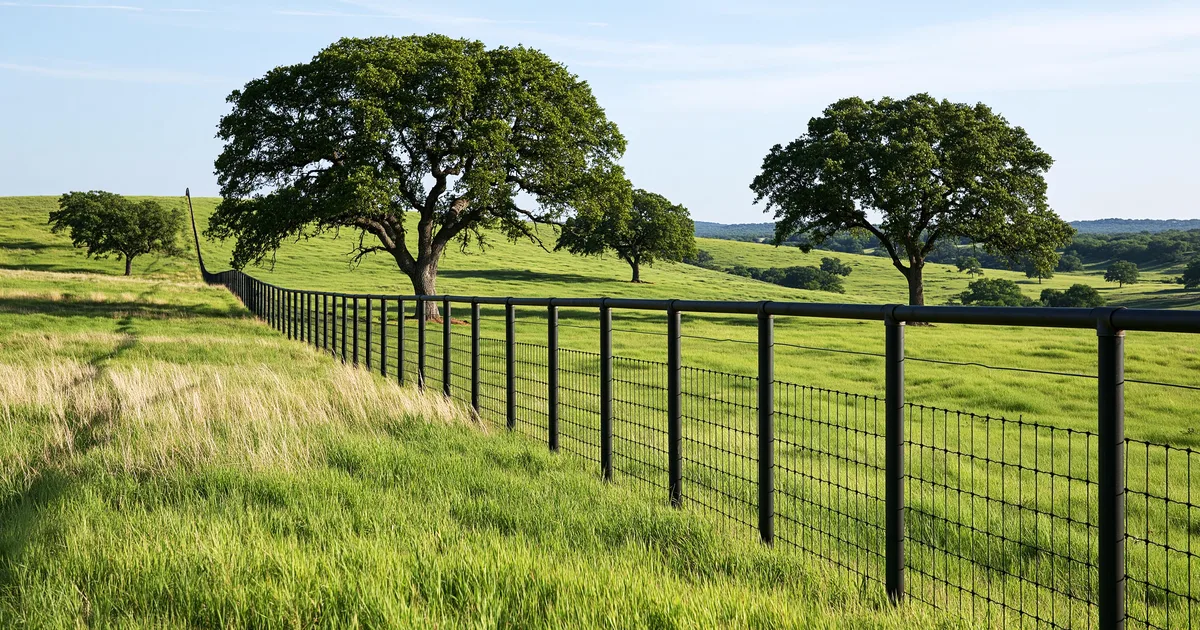
The cost to fence 10 acres depends less on the acreage than on how many feet of perimeter fence go around it, and that depends on the shape of the land. Here's how to turn acres into feet, what each kind of fence runs around Boerne and the Texas Hill Country, and what pushes an acreage job up or down.
Start With Feet, Not Acres
Fence installations are priced by the linear foot, so your first step is converting acres into a measurable perimeter. Property owners often ask exactly how many feet of fence for 10 acres they will actually need. A perfectly square 10-acre tract spans roughly 660 feet on each side, which calculates to exactly 2,640 feet of continuous fence line.
That 2,640-foot measurement is your baseline number when pricing out pipe and ranch fencing or standard wire mesh. We always recommend checking your official plat map to verify property corners before ordering materials. A square 10 acres is 2,640 feet around, but an irregular boundary can easily push past 3,000.
10 Acres at a Glance
On a square 10 acres, the perimeter fence alone runs from about $21,120 for wire to about $118,800 for pipe. These numbers assume fairly level ground, before gates or clearing.
| Fence type | Per foot installed | Square 10 acres (about 2,640 ft) |
|---|---|---|
| Pipe fence, top rail with wire or pipe and cable | $20 to $45 | About $52,800 to $118,800 |
| Deer or wire fence, up to 8 ft acreage fence | $8 to $20 | About $21,120 to $52,800 |
Those base numbers represent the fence alone. Most 10-acre jobs require at least one main drive gate and several walk gates.
Why Your Tract Is Probably Longer Than 2,640 Feet
Hardly any Hill Country property forms a perfect square, which means your actual fence line will likely measure longer than the baseline 2,640 feet. The physical shape of your acreage directly impacts the amount of material required.
Long, narrow tracts take more fence to close in the same amount of land. A 10-acre rectangle twice as long as it is wide adds about 160 feet.
| Tract shape (10 acres) | Approximate perimeter |
|---|---|
| Square | About 2,640 ft |
| Rectangle, 2 to 1 | About 2,800 ft |
| Long and narrow, 4 to 1 | About 3,300 ft |
| Irregular, following draws and tree lines | Often longer still |
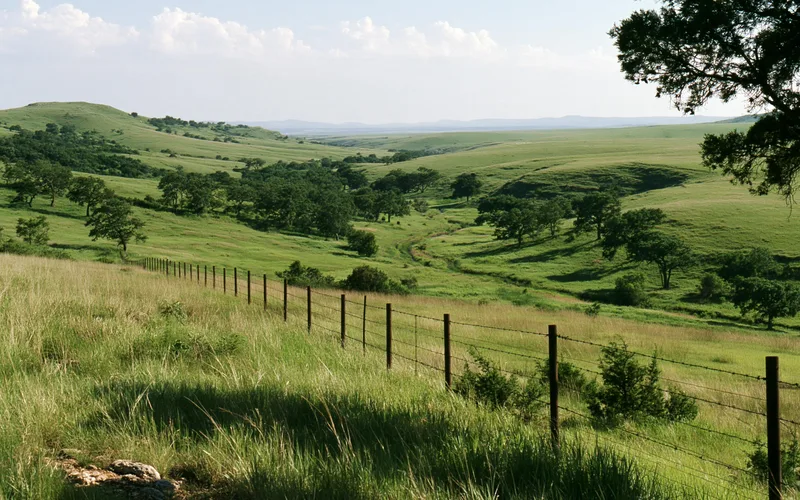
The most accurate way to calculate your real number is directly from a professional survey or plat map. You should add up all the boundary lines, subtract any existing stretches that remain in good shape, and include any planned interior cross fences.
Go along your property line and look for anything that will make the fence jog: a draw, a big tree, a rock outcrop. It's the easiest way to avoid surprises.
Picking the Fence Type
Selecting the right fence material depends entirely on your livestock containment goals and your visual preferences for road frontage. Pipe structures offer maximum durability, while wire options provide cost-effective coverage for long boundary lines.
Pipe fence: $20 to $45 per foot
Pipe fencing utilizes a welded top rail paired with wire or cable to create a heavy-duty, highly visible barrier. This style costs between $20 and $45 per linear foot fully installed.
Pipe is the usual pick for horse paddocks and high-traffic road frontages where curb appeal matters most.
Wire fence: $8 to $20 per foot
Wire fencing options range from $8 to $20 per linear foot and utilize T-posts supported by braced corners. This cost-effective category includes several specific materials:
- Standard barbed wire (four to five strands)
- Welded wire mesh for smaller livestock
- Traditional woven field fence
- High game containment netting
We recommend these budget-friendly options for sprawling back property lines where visual aesthetics take a back seat to sheer distance. For specific details on keeping wildlife controlled, review our guidelines on deer and game fencing.
Mixing types
Combining different fence styles allows you to secure your entire property without paying premium prices for every single foot. Plenty of owners choose welded pipe for the road frontage and switch to wire along the hidden back boundaries.
On a square 10 acres, 660 feet of pipe along the road and 1,980 feet of wire around the rest of the perimeter runs about $29,040 to $69,300 before gates. All pipe would be $52,800 to $118,800.
What Affects the Price on Acreage?
Hidden site conditions like solid rock, steep terrain, and heavy brush will heavily influence your final installation price. The base per-foot rate only covers standard soil and clear, level ground.
Here are the primary variables that drive up costs:
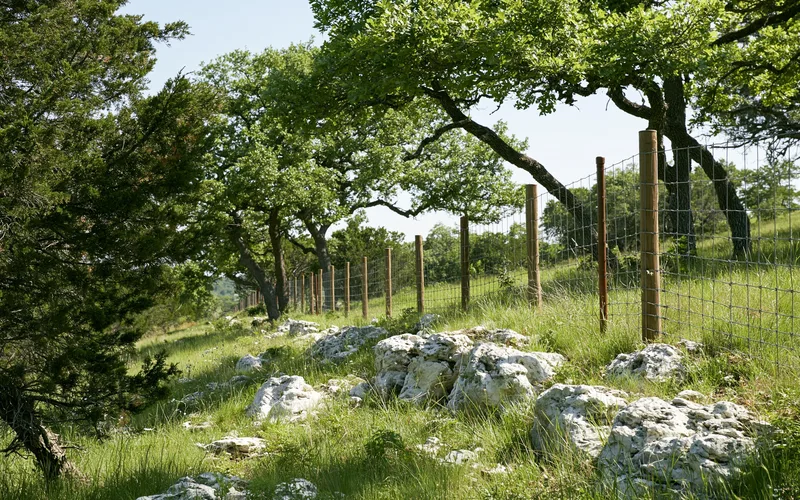
- Rock and limestone: Corner and brace posts carry the entire tension of the fence, requiring deep drilling into stony uplands. Drilling those holes adds labor at every corner and brace.
- Terrain changes: Steep slopes, winding draws, and low spots require extra posts and custom fitting to keep the wire tight against the ground.
- Brush on the line: Every fence needs a perfectly clear line for straight installation. Heavy cedar clearing along a boundary adds to the site preparation budget, and we price it after walking the line.
- Height and wire type: An 8-foot game fence requires significantly more material and labor than a standard four-strand barbed wire layout.
- Corners and gates: Every single change in direction requires a structural brace, and every gate demands heavy-duty support posts.
Don’t Forget Gates
Gates are priced on their own. Most 10-acre properties need at least one drive gate at the road and a walk gate or two.
| Gate | Price |
|---|---|
| Walk gate | $150 to $400 |
| Double drive gate | $400 to $1,200 |
| Automatic driveway gate, installed complete | $3,000 to $12,000 |
On rural Texas land, if you want the entry automated and there's no power at the road, a solar operator is the usual answer. Our driveway and automatic gates page covers what goes into the price. Set gate posts deep in concrete, so the gate doesn't sag.
High Fence on 10 Acres
An 8 ft high fence for deer or exotic game is a bigger build: taller posts, heavy braces, a cleared line and wire stretched tight. It falls in the $8 to $20 per foot range for deer and wire fence, toward the high end. Our guide on how high fence is built walks through each step.
Cross Fencing and Pens Add Up Too
The outer perimeter only represents one part of a comprehensive acreage fencing plan. You will need interior cross fences and holding pens if you plan to:
- Rotate active pastures seasonally
- Separate horses from cattle herds
- Create dedicated containment runs near a barn
A single cross fence splitting a square 10-acre property directly in half adds roughly 660 linear feet to your materials list.
Splitting the same property into four quarters adds about 1,320 feet. You should price each interior stretch at its own specific per-foot rate since back pastures rarely need to match the expensive road frontage.
Build in phases if you need to
You don't have to fence the whole perimeter of 10 acres at once. Many owners secure the road frontage and main entrance first, leaving the rear property lines for the following season.
The key to phased construction is mapping out the entire layout during the initial design stage.
We recommend setting all the critical H-braces, corners, and gate posts during phase one so the framework is ready when you expand. This preparation makes future additions much easier.
Putting a Budget Together
Finalizing your budget requires measuring the exact property footprint, selecting materials, and calculating the impact of local terrain. Following a structured planning process ensures you account for every hidden variable before construction begins.
Here is the best way to estimate your total costs:
- Get the exact perimeter measurement from your official survey, or physically measure the line.
- Decide which specific stretches get premium pipe and which get standard wire.
- Multiply each separate stretch by its typical per-foot cost range.
- Add the flat costs for all walk gates and automated driveway entries.
- Expect rock drilling, steep slopes, and thick brush clearing to push your final number toward the upper end of the price range.
For a full table of every fence type and the acreage fence cost in Texas per foot, see our fence cost per foot guide.
When you're ready, we'll come out to your land around Boerne, look at the fence line with you, and give you a free written estimate. It helps to have your survey or plat in hand, with the corners marked.