
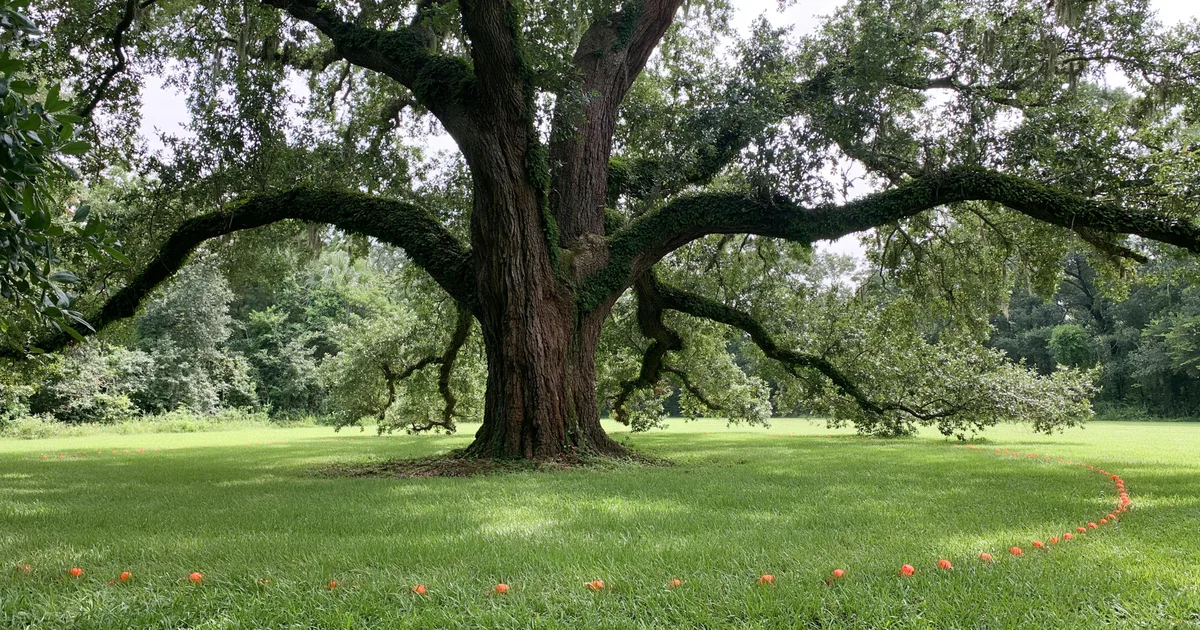
Live oaks give a Boerne yard its Hill Country feel, and they're worth protecting when you build a fence near them. Oak wilt is caused by a fungus, Bretziella fagacearum, and it spreads two ways. Sap-feeding beetles carry it into fresh wounds, and it travels from tree to tree through connected roots.
That's why fence post holes near a live oak need a plan, so the roots and bark stay as whole as possible. We map the fence line around your trees before the first post hole is dug.
Why Live Oaks Need Care When You Build a Fence
Most of a live oak's roots are shallow and spread well past the branches, right where fence posts go. Cutting a big root stresses the tree, and any fresh wound is an opening for the beetles that carry oak wilt.
Once oak wilt gets into a neighborhood, stopping it is expensive. In 2026 the Texas A&M Forest Service raised its cost-share for trenching, which breaks the root-to-root spread, to up to $5,000. Preventing a wound costs a lot less.
So we treat the ground under and around the canopy carefully, and plan the post spots before anyone digs.
Who Oversees Oak Wilt in Boerne?
In Boerne, the Permitting and Code Compliance office handles fence permits and also oversees oak wilt regulations. A fence permit in Boerne needs an application and a site plan showing where the fence will go. If live oaks are near the line, put them on the site plan and ask the city what applies before you dig. Our fence permit guide covers the application.
A good site plan near oaks shows:
- The fence line
- The live oaks near it
- How far each trunk is from the post spots
- How the line avoids the big roots
How to Plan a Fence Line Around Live Oaks
Building a fence near a live oak comes down to where the posts land. We plan it in three steps.
Mapping and Spacing
We mark every live oak near the line on the site plan, along with how far each trunk is from the fence. Most fence sections run about 8 feet between posts, so there's usually room to slide a post spot a little to miss the trunk and the biggest surface roots. Moving one hole a few inches can save a major root.
Adjusting the Fence Path
A fence line doesn't have to be dead straight. A gentle jog around a big trunk often looks better than a straight run cut through the roots. We pull a string line to try different paths, so you can see where the fence will go before any concrete gets mixed.
Digging and Timing
We drill small, neat holes instead of digging trenches, which keeps the disturbance to a minimum, and we keep dug-out dirt off the bark. Timing matters too. The Texas A&M Forest Service says to avoid wounding oaks from February through June, when the beetles that spread oak wilt are most active. Near live oaks, that's the window to work around if you can.
Does Rock Make It Harder?
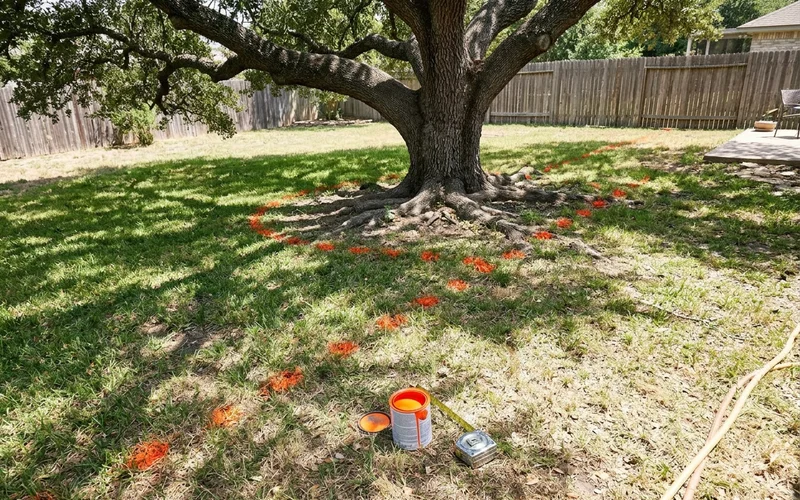
Sometimes rock helps. Across the uplands of Kendall County, limestone sits close to the surface, so oak roots spread out wide and shallow instead of going deep. When we drill a post hole into that rock, we place it in a gap between the roots, and the post ends up set solid in stone.
For more on digging through rock, read our guide on how deep fence posts go.
What If You Already Have a Fence Near an Oak?
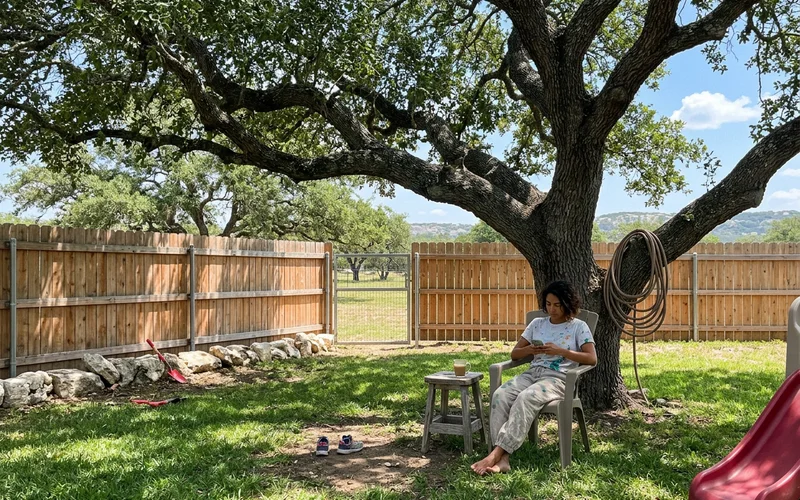
Fixing an old fence near an oak takes the same care. If a rotted post sits right next to a trunk, it has to come out without tearing the bark.
The Texas A&M Forest Service says to paint any fresh oak wound right away, any time of year. A thin coat of latex or pruning paint does the job. It keeps the beetles from getting to the wound.
When replacing old sections near an oak, focus on:
- Clearing fallen limbs carefully to avoid crushing healthy roots
- Treating any accidental bark scrapes with paint immediately
- Keeping heavy equipment away from the base of the trunk
- Reusing existing post spots to prevent new cuts
We reuse the old post holes when we can, because working in the original spots means no new root cuts.
Other Trees on the Fence Line
Live oaks get the most attention, but cedar elms and Ashe junipers grow along a lot of the same fence lines, and their roots can push a wood fence out of line over time. We note every big trunk on the plan, so gates have room to swing and sections stay straight. Low, heavy branches over the line are worth trimming before a storm brings them down on the new fence. Near oaks, do that trimming outside the February-to-June window.
The Bottom Line
You can build a fence through a wooded lot without hurting the oaks. It comes down to planning the line around the roots, painting any wound right away, and staying out of the February-through-June window when the beetles are most active.
We'll come out, look at the trees and the fence line with you, and give you a free estimate for your fence near live oaks in Boerne.